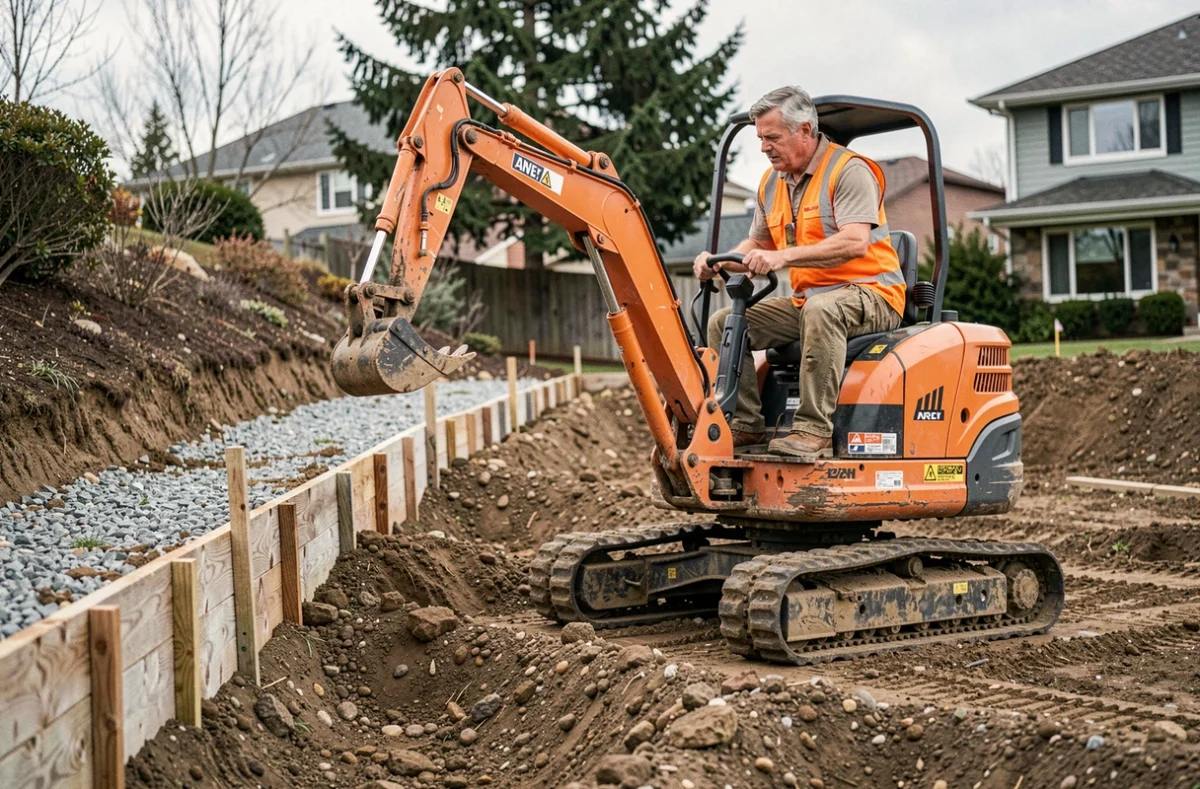
Excavation on flat land and excavation on a slope do not pose the same problems, and especially not the same bills. The volume of earth to be moved, the type of soil encountered, and the slope of the land significantly affect the cost of sloped excavation. Before comparing quotes, it is essential to understand what truly impacts the budget and what administrative obligations apply depending on the scale of the work.
Cost of sloped excavation: comparison by technique
Not all excavation methods are equal when dealing with a slope. The choice depends on the final project (construction, pool, garden landscaping) and the degree of slope. Here are the price ranges derived from market data.
| Technique | Average price per m² | Main use |
|---|---|---|
| Elevation of the ground (fill) | 30 to 70 € | Create a flat platform on a gentle slope |
| Following the slope (terraces) | 40 to 90 € | Terraced garden, landscaping |
| Embedding in the ground | 80 to 130 € | Semi-buried construction |
| Moving the land (complete remodeling) | 90 to 160 € | Deep modification of the relief |
The gap between elevation and complete remodeling can therefore exceed three times the price per square meter. This differential is explained by the volume of extraction, the need for earth removal, and the complexity of the associated retaining structures.
To delve deeper into these ranges and understand each line item of expenditure, Encore Le Printemps’ advice for excavation details each budgetary variable.
Land slope and soil type: the two factors that widen the gap
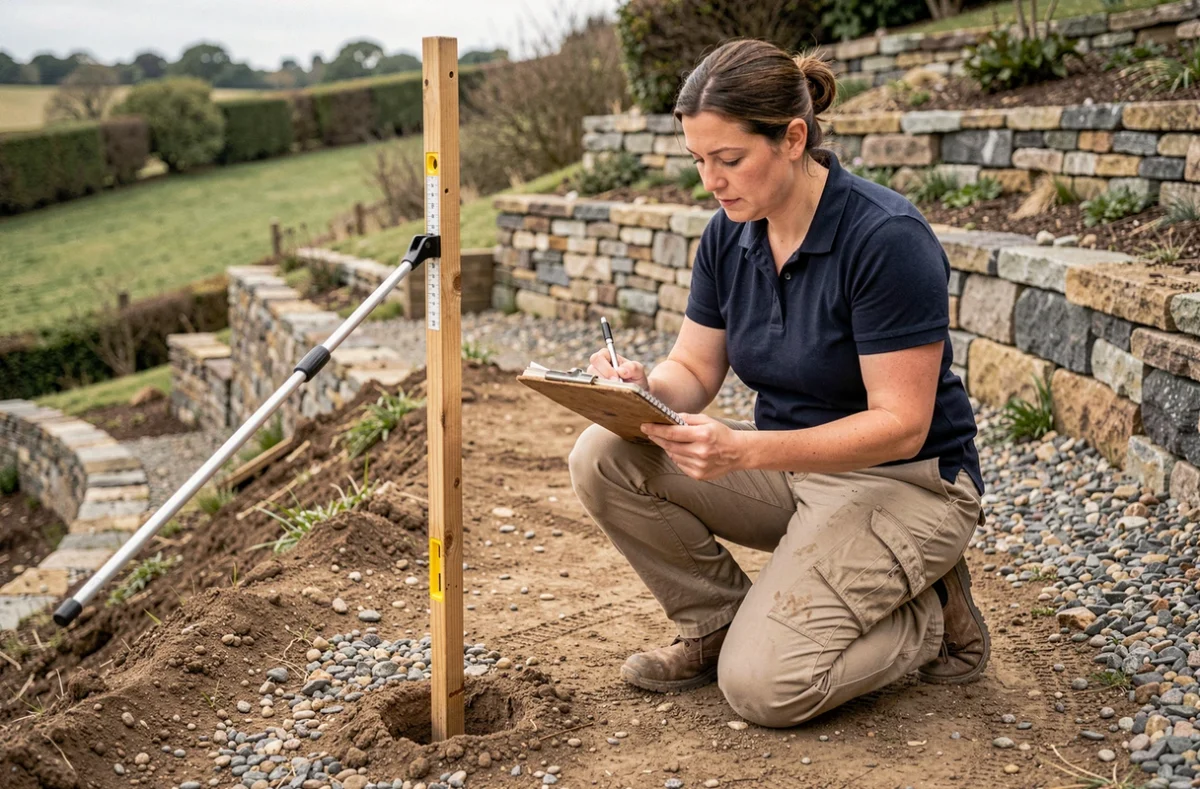
The percentage of slope directly conditions the chosen method. On a gentle slope (less than 8%), simple leveling is often sufficient. The excavator removes the topsoil, levels, and compacts. The cost remains close to that of flat land.
From 8 to 15% slope, cut-and-fill becomes the norm. It is necessary to excavate upstream and move the earth downstream to create a stable base. This operation requires precise volume calculations to balance the masses of earth and limit removal, a cost item often underestimated.
Beyond 15%, retaining structures (walls, gabions, reinforced concrete walls) become almost systematic. Their sizing depends on the earth pressure, runoff management, and the geological nature of the soil.
Clay, rocky, or sandy soil: the concrete impact
Rocky soil requires a hydraulic rock breaker, which extends the duration of the project and significantly increases the bill. Clay soil poses an opposite problem: it retains water, swells, and shrinks, which weakens the stability of the fills without proper drainage.
- Rocky soil: slow extraction, high machine cost, but excellent load-bearing capacity once excavated
- Clay soil: mandatory drainage, risk of sliding if runoff is not channeled
- Sandy or silty soil: quick excavation, but delicate compaction and accelerated erosion without vegetation
A soil study (G2 study in the pre-project phase) allows for quantifying these constraints before the first shovelful. On sloped land, it is not a luxury: it prevents discovering a rocky outcrop or a perched water table in the middle of the project.
Urban planning permits for sloped excavation: the thresholds to know
Competitors rarely address this point in detail, even though it can block a project. The rules vary according to the area and depth of modifications made to the natural relief.
Excavations or elevations of more than 2 meters over more than 100 m² may require a development permit, rather than just a prior declaration. This threshold, often overlooked, directly concerns excavations on steep slopes where significant volumes of earth are moved.
For terraces on pedestals, the rule also becomes clearer: beyond approximately 60 cm above the natural ground, the terrace is considered elevated. A prior declaration is then required for areas between 5 and 20 m², or even a building permit beyond that.
The cross-section: a document often poorly done
As soon as the terrain profile is modified, the cross-section must show the initial state and the future state of the relief. This document accompanies the permit application and allows the reviewer to assess the actual impact of the work. On sloped land, an approximate cross-section is the quickest way to receive a rejection or a request for additional documents.
Managing runoff on sloped land: a technical item in its own right
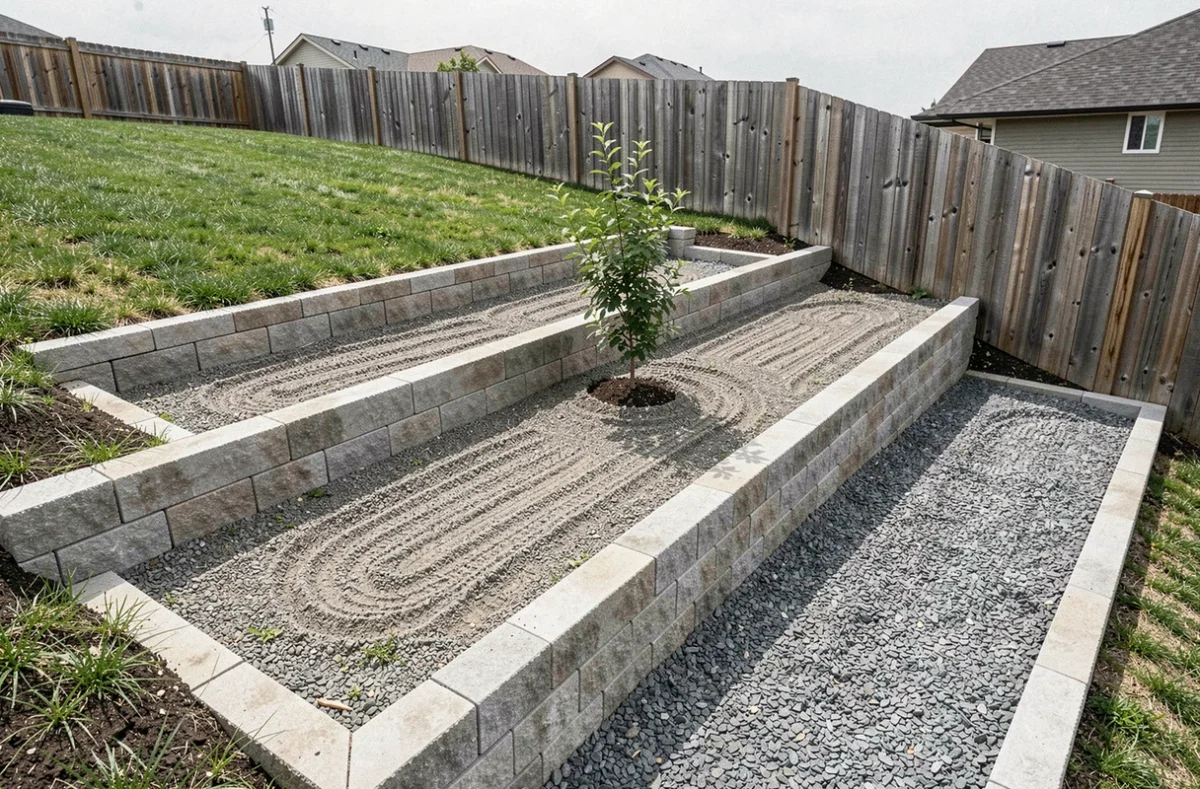
Water flowing down a terraced slope does not just disappear. If it is not captured and directed, it erodes the fills, undermines the retaining walls, and can cause infiltrations in the foundations or constructions below.
- Peripheral drains at the foot of the slope to intercept water before it reaches the structures
- Collection ditches at the top of the slope to reduce downstream flow
- Vegetation of the slopes (deep-rooted grasses, geotextile) to stabilize the soil and slow erosion
- Landscaped swales on intermediate terraces to infiltrate water into the soil rather than discharge it into the network
Addressing runoff at the same time as excavation costs significantly less than revisiting a project after the first damages. A common mistake is to budget for excavation alone, only to discover that drainage represents an unexpected additional cost of several thousand euros.
On lands where the slope exceeds 15%, hydraulic management is no longer an add-on: it is an integral part of the excavation sizing. An excavator who does not include it in their quote leaves part of the problem to the owner.
The choice of technique, the actual budget, and the durability of the result all depend on three data points that only the land can provide: its exact slope, the nature of its soil, and its behavior in relation to water. A quote without prior study of these parameters remains an estimate, not a price.