
Some animal species known for their solitary behavior surprisingly exhibit a capacity for individual recognition. Contrary to the common belief that reptiles are unable to distinguish one human from another, scientific observations confirm selective memorization in certain individuals.
Experiments conducted in laboratory and domestic environments reveal differentiated responses depending on the interlocutor, suggesting the existence of identification criteria unique to each turtle. These results challenge our understanding of interspecific relationships and the behavioral plasticity of these often underestimated animals.
The unsuspected abilities of the turtle: perception, memory, and social intelligence
In the shelter of the tumult, the land turtle moves cautiously through a world it deciphers with an attention rarely suspected. Far from being insensitive, it observes, retains, and learns. Its sight distinguishes familiar outlines, and its memory records repeated actions. Its sense of smell and hearing are far from rudimentary: they help it recognize, day after day, the human who is part of its environment.
Moreover, the memory of the turtle is not limited to a few automatisms. It retains the routines of daily life, recognizes the voice, the smell, and even the gait of the person who cares for it. Thus, how a turtle recognizes its owner can be explained by a patient association of visual, olfactory, and auditory signals, far from being a mere matter of habit. This ability demonstrates how much animal intelligence exceeds stereotypes about the coldness of reptiles.
The behavior of the turtle, often interpreted as distant, actually conceals a subtle body language. A gentle approach, calm gestures, a constant environment: these details gradually establish trust. Conversely, nervousness, noise, or overly frequent handling shake the animal’s inner security and alter its way of interacting.
In the case of the Hermann’s tortoise, a symbol of longevity and fidelity, this social intelligence is expressed daily. Attached to its landmarks, it adapts, observes, loyal to those who respect its pace and space.
Can a turtle really recognize its owner? What studies and observations say
Through observations conducted with the land turtle, one conclusion stands out: the bond with humans is far from anecdotal. Researchers and breeders are adamant. Recognition involves a whole set of signals: voice, smell, silhouette. The turtle’s memory fixes the routines of daily life. Offering food, repeating certain gestures, being present at regular times—all of this ultimately forges undeniable familiarity.
The domestic turtle does not seek affection like a dog, but it can express a surprisingly strong form of attachment. Some specimens do not hesitate to follow their owner around the enclosure. Others approach with their heads to rub against an outstretched hand. A few even allow themselves to be touched on the shell, a sign of trust built over time. These behaviors, rare but well-documented, demonstrate the memory and association capabilities of these animals.
Here, in concrete terms, is how this recognition is expressed in turtles:
- Recognition through memory of routines: feeding, repeated gestures, daily regularity
- Identification via visual, olfactory, and auditory cues unique to each person
- Signs of affection: following the owner, approaching voluntarily, accepting or seeking physical closeness
Independent by nature, the turtle thus builds a unique relationship with its owner. Without excessive demonstration, without effusion, but with consistency and loyalty, it weaves a silent, strong, and authentic bond.
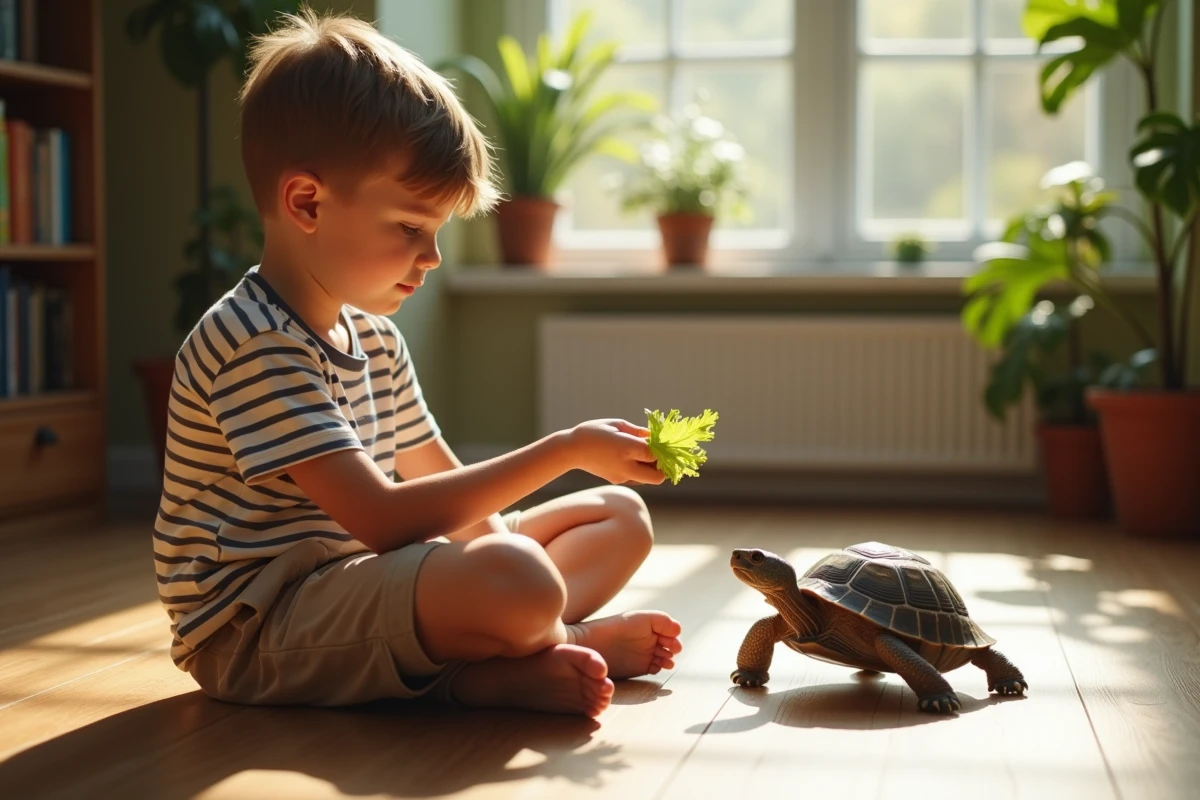
Creating a unique bond: gestures, habits, and attitudes that foster attachment in turtles
The land turtle is characterized by its reserve, but the bond with its owner is built day by day in the simplicity of gestures and respect for its rhythm. Those who share their life with a turtle quickly learn the importance of regularity. Coming every day at the same time, moving slowly, establishing routines around feeding or cleaning the enclosure—all of this creates a common language.
Rituals and trust: the strength of the everyday
To create or strengthen this bond, certain gestures prove particularly effective:
- Presenting food regularly and without haste
- Allowing the turtle to move at its own pace, without handling it more than necessary
- Creating a calm and stable environment, as the domestic turtle perceives and reacts to every change
Respecting the turtle’s natural rhythm changes everything. It does not spontaneously approach humans, but it observes, analyzes, and associates regular presence with a positive experience. When it moves towards an outstretched hand, follows the caregiver’s steps, or accepts a caress, it is a sign of a very real attachment, even if it remains discreet.
Familiarity with the turtle is thus built in gentleness, consistency, and absence of stress. Agitation, noise, and frequent handling strain this fragile bond. However, true to its independent temperament, the turtle reserves its trust for those who know how to respect its codes and pace.
The relationship between a turtle and its owner is unlike any other: it is built step by step, in patience and attention. Those who experience it know: behind the shell, there is sometimes a silent loyalty that reveals itself to those who know how to wait.